One-on-One Manual Therapy
Direct hands-on work to the jaw, face, cervical spine, and thoracic cage. Fascial release and joint mobilization along the full chain from skull to diaphragm. This is the foundation of every session.
Learn more →
Vocal strain, jaw tension, lost power, chronic throat tightness. These are not throat problems. They are movement problems. And they respond to hands-on treatment that most singers and speakers have never been offered.
Dr. Maks Birikov, DPT, is the first and only Functional Patterns practitioner in Baltimore, and the first master-level dry needling practitioner in the state of Maryland.
Request a ConsultationFull-hour, one-on-one sessions in Fells Point. No referral required.
When a singer loses vocal power, the problem rarely starts at the throat. It begins in the jaw, travels through the tongue, and connects to the diaphragm. That chain from jaw to tongue to breath support is the actual mechanism behind most chronic vocal tension. Treating the throat in isolation is like treating a knee without looking at the hip.
The jaw is not just a hinge. It is anchored by muscles that share fascia with the tongue, the floor of the mouth, and the structures that govern breath. When the jaw braces from stress, from technique, from years of compensating, the tongue follows. A tense tongue cannot release into the resonant space a singer needs. And a restricted tongue shortens the breath cycle before the diaphragm ever gets a chance to do its job.
This is why voice lessons, speech therapy, and even surgery sometimes fail to produce lasting change. The tissue restriction is upstream. It has to be addressed manually, at the source.
Most singers are told to relax the jaw. That instruction is correct but incomplete. The jaw does not hold tension in isolation. It holds tension because the surrounding fascial system is restricted. Fascia is the connective tissue that wraps every muscle and links structures across the body. When it tightens in one area, it pulls on adjacent areas. The jaw, the tongue, the suboccipital muscles at the base of the skull, and the anterior neck all share this web.
The diaphragm sits at the bottom of that chain. It is the primary muscle of breath, and it cannot move freely when the structures above it are braced. A singer with chronic jaw tension is almost always a singer with restricted diaphragmatic excursion, meaning shallower breath, less control, and a voice that fatigues faster than it should.
The same pattern appears in speakers, voice-over artists, teachers, and anyone who uses their voice under sustained demand. The tissue does not know the difference between an aria and a three-hour lecture. It responds to load the same way.
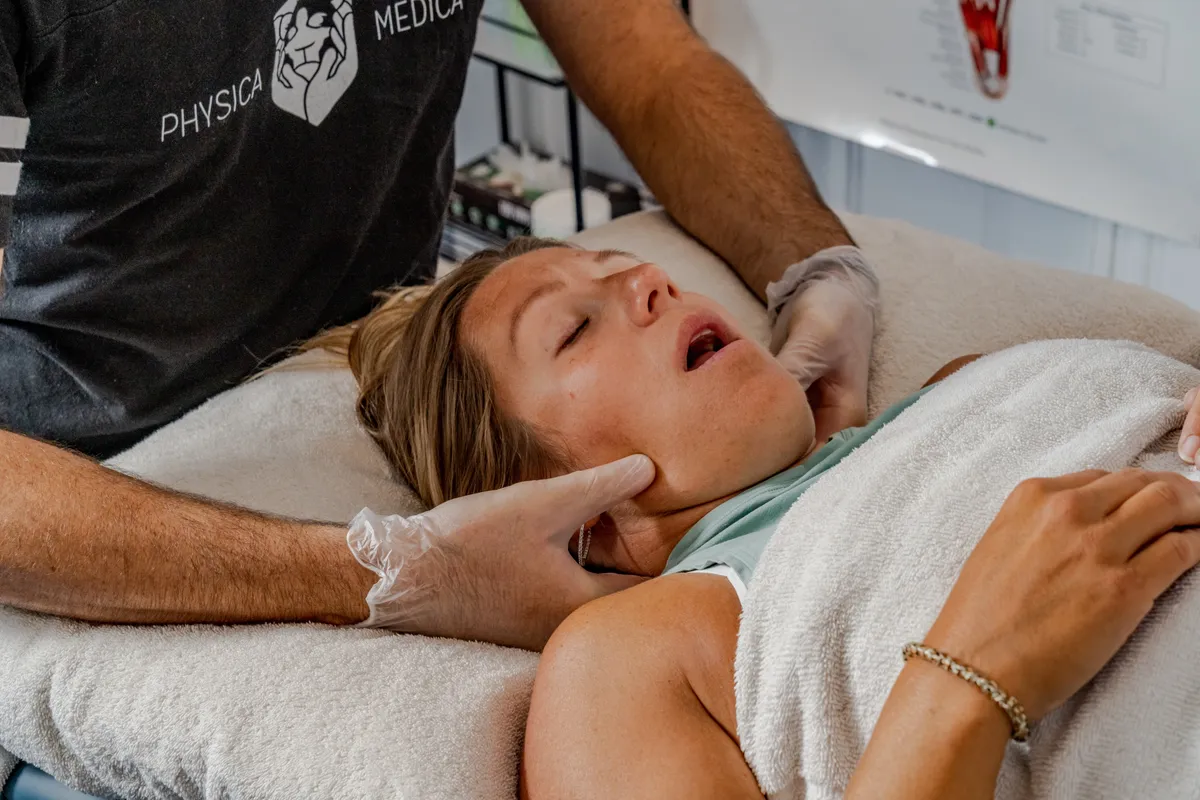
The assessment starts with the whole system: head position, jaw mechanics, cervical and thoracic mobility, rib cage movement, and how the breath actually moves through the body. Not just the throat. Not just the jaw. The full chain that connects them.
Direct hands-on work to the jaw, face, cervical spine, and thoracic cage. Fascial release and joint mobilization along the full chain from skull to diaphragm. This is the foundation of every session.
Learn more →Instrument-assisted soft tissue mobilization uses precision steel instruments to identify and break down adhesion in the fascia. The instruments transmit texture back to the clinician's hand, allowing targeted work in areas where manual pressure alone cannot reach the depth of restriction.
Learn more →A fine filament needle is placed directly into a trigger point in the affected muscle, causing an involuntary release of the contracted tissue. For cervical and suboccipital muscles that contribute to jaw and tongue tension, this produces a depth of release that manual work alone cannot achieve. Dr. Birikov holds a master-level dry needling credential and performs this under Maryland PT licensure.
Learn more →Negative pressure lifts the fascia away from the layers beneath it, creating space and restoring glide between tissue planes. Used along the neck, thoracic spine, and rib cage to decompress structures that restrict breath mechanics. Cupping can leave temporary circular marks on the skin that fade within a few days.
Learn more →Direct intraoral and extraoral release of the masseter, pterygoid, and temporalis muscles. This is the most direct intervention for jaw-driven vocal tension and is often the piece that produces the most immediate change in resonance and breath support.
Learn more →A stiff thoracic spine limits how far the rib cage can expand on inhalation. Mobilization restores that movement, giving the diaphragm the space it needs to descend fully. For singers and speakers, this is often the difference between a breath that supports the phrase and one that runs out before the line ends.
Learn more →Physica Medica is located at 800 S Bond St in Fells Point, Baltimore. No referral is required to book. If you are traveling to Baltimore for a performance engagement and want treatment before or during your run, that can be accommodated. Contact the clinic directly to discuss timing.
Dr. Birikov reads every inquiry personally and responds directly. Describe what you are experiencing, how long it has been present, and what you have already tried. That information shapes the first session before you arrive.
Most patients working on vocal performance issues see meaningful change within four to six sessions. Some notice a shift in the first or second. The pace depends on how long the restriction has been present and how the tissue responds, which is why the assessment comes first.
If you have already worked with a voice teacher, a speech therapist, or a general PT and you are still dealing with the same tension, that is not a sign that the problem is unfixable. It is a sign that the tissue restriction driving it has not been addressed yet. That is a different problem with a different solution.
The jaw-tongue-diaphragm chain is not a theory. It is anatomy. And it responds to manual work when that work is applied precisely, by someone who understands how the pieces connect.
443-228-8029.
Describe what you are experiencing: the tension, the fatigue, the loss of range, how long it has been there, and what has already failed. That context is what makes the first session productive rather than exploratory.
Dr. Birikov reads every message personally and responds directly. No front desk, no intake coordinator.