
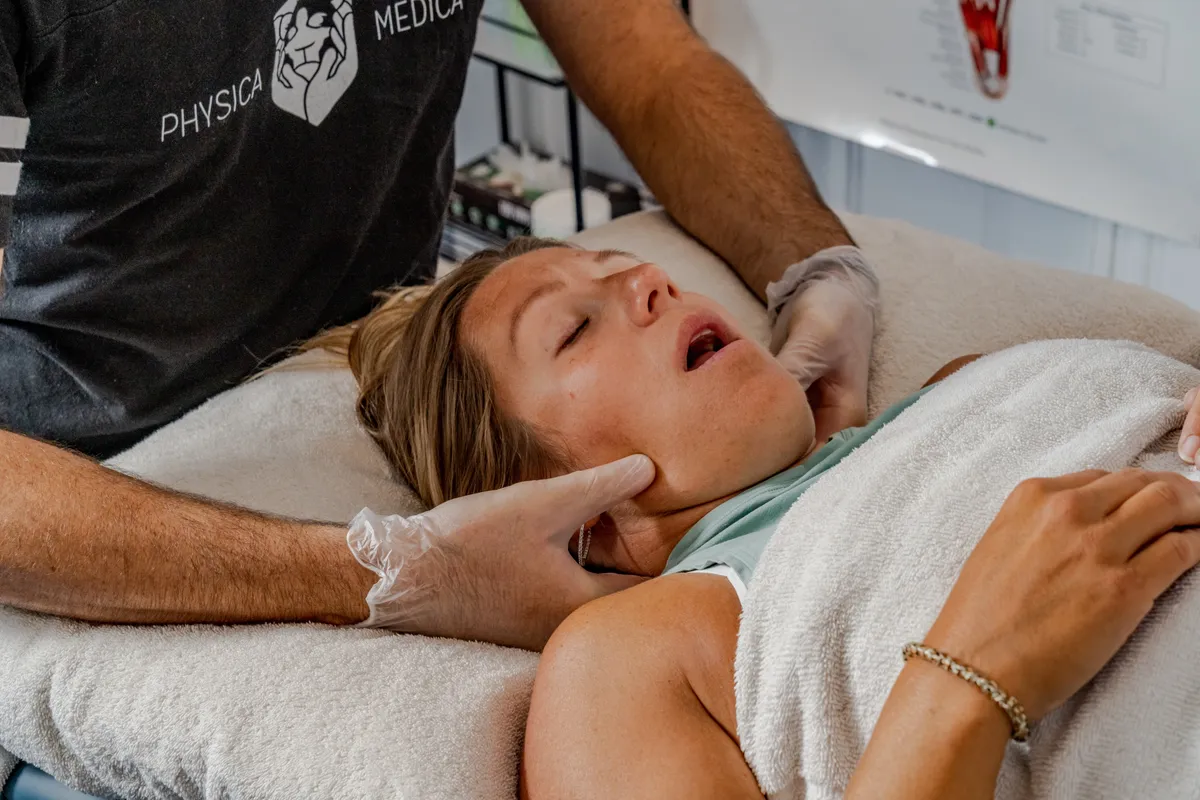
TMJ and Jaw Therapy in Baltimore
Dr. Maks Birikov, DPT treats jaw dysfunction, facial tension, and the muscle chains that drive TMJ pain, including the connections to your neck, your headaches, and your voice. Physica Medica is located at 800 S Bond St, Baltimore, MD 21231.
Every session is a full hour of hands-on manual therapy with Dr. Birikov. No aides, no exercise handouts, no shared appointment time. Soft tissue work, joint mobilization, and intraoral release when indicated.
Out-of-network by design. HSA and FSA accepted.
TMJ Dysfunction Is Rarely Just a Jaw Problem
Most patients who arrive here have already been through the dental pathway. Night guard fitted. Stress management recommended. Maybe an oral surgery consultation that led nowhere. The jaw was treated as the problem. But the jaw is usually where the problem lands, not where it starts.
The masseter and pterygoid muscles, the primary muscles that close and load the jaw, are directly connected to the cervical spine through the fascial system. When the neck is held forward, as it is in nearly everyone who sits at a screen for hours a day, those muscles compensate. They brace. Over time, they shorten. The joint takes the load. That is what produces the clicking, the locking, the headaches at the temples, the ache behind the eyes.
There is more to your TMJ problem than you have been told. That is not a criticism of your previous providers. It is a description of what dentistry is equipped to address and what it is not. A night guard manages the symptom at the tooth surface. It does not release the muscle driving the compression.
How Dr. Birikov Approaches TMJ and Jaw Therapy
The assessment starts above and below the jaw simultaneously. Cervical spine mobility, forward head position, hyoid bone tension, and breathing pattern are all evaluated before any work begins at the jaw itself. This is not a formality. These findings directly change what gets treated and in what order.
This is for you if
- You want hands-on bodywork: fascia, joint, nerve, needle. Not a program of exercises.
- You have already tried PT, massage or chiropractic and are still in pain.
- Your problem is chronic, recurring, or has never been explained to your satisfaction.
- You would rather have one hour with the doctor than three appointments with three people.
- You are willing to pay out of pocket for undivided expert attention.
This is not for you if
- You are looking for an exercise-based rehab program supervised by an aide.
- You need a clinic that bills your insurance directly and books you three times a week.
- You have an acute traumatic injury that needs imaging or surgical evaluation first.
- You want a single visit that makes a decade-old pattern disappear.
What TMJ Therapy at Physica Medica Involves
The muscles that load the TMJ are treated directly. This means sustained manual pressure into the masseter and temporalis, the muscles along the jaw and temple, to release trigger points and restore normal resting tone. When a muscle has been bracing for months or years, it does not relax on its own.
Soft tissue mobilization
The medial pterygoid sits inside the jaw and is inaccessible from the outside. Releasing it requires gloved intraoral work. This is one of the most effective interventions for TMJ compression and clicking, and it is something a dentist or oral surgeon does not perform. It is also the treatment most patients with chronic TMJ have never received.
Intraoral release
Forward head posture increases the load on the TMJ by changing the resting position of the mandible. Joint mobilization of the upper cervical spine and manual release of the suboccipital muscles address the structural driver of that load. This is why some patients notice their jaw symptoms improve when their neck is treated.
Conditions Connected to Jaw Dysfunction
TMJ dysfunction rarely travels alone. These are the conditions most commonly treated alongside jaw therapy at Physica Medica:
- Chronic headaches and migraines driven by jaw-cervical tension
- Neck pain and upper cervical restriction
- Tinnitus and ear fullness related to muscle tension near the joint
- Facial pain and trigeminal nerve irritation
- Jaw clicking, locking, or limited opening
- Vocal tension and tongue restriction in singers and speakers
- Bruxism and clenching that a night guard has not resolved
- Post-surgical restriction following jaw or dental procedures
Why Singers, Speakers, and Migraine Sufferers Seek This Work
History, briefly
Singers and professional speakers often arrive here after being told their vocal tension is a technique problem. Sometimes it is. More often, the restriction is structural. Jaw tension transmits directly into the tongue through shared fascial connections. A tight jaw means a restricted tongue. A restricted tongue means a compressed larynx. The voice that feels effortful or strained is frequently a jaw problem that has never been identified as one.
Assessment by hand
The chain runs further. The tongue connects to the hyoid bone, which connects to the muscles of the throat and upper chest, which affect how the diaphragm moves. A singer with unexplained breath support issues or a speaker who fatigues within an hour may have a jaw and tongue restriction pattern at the root of it. This is not commonly known outside of specialized manual therapy practice.
Treatment, same visit
For migraine and headache patients, the jaw-cervical connection is the most overlooked piece of the picture. The trigeminal nerve, the primary sensory nerve of the face and head, passes through tissue that is directly affected by masseter and pterygoid tension. Chronic overload of those muscles can sensitize the trigeminal system over time. Many patients who have managed migraines with medication for years see a meaningful reduction in frequency when the jaw and cervical tension driving the pattern is addressed directly.
An honest arc
Before you leave, an estimate of how many sessions this will take and what will change first. Most patients feel meaningful change within four to six.
Deep manual work can be intense while it is happening and can leave a day or two of soreness, the kind that follows hard exercise rather than injury. Cupping can leave circular marks that fade within a week. Dr. Birikov talks through pressure as he works and adjusts on request. Nobody is asked to endure anything silently.
Schedule Your TMJ Assessment in Baltimore
How is one-on-one physical therapy different from PT at a regular clinic?
If you have worn a night guard for years and still wake up with jaw pain, or if your headaches have been attributed to stress without anyone examining the muscles that might be causing them, this is the assessment you have not had yet. No referral is required to book.
How many sessions will I need?
Most patients with TMJ dysfunction and related headaches see meaningful change within 4 to 6 sessions. How quickly depends on how long the pattern has been present and how many structures are involved. Chronic cases with cervical involvement typically take longer than recent-onset jaw restriction. Dr. Birikov will give you a specific estimate after the first session, not a vague range designed to avoid commitment.
Do you take insurance for one-on-one physical therapy?
Physica Medica is out-of-network. Sessions are billed directly at a flat rate. HSA and FSA cards are accepted. A superbill can be provided for out-of-network reimbursement if your plan includes it.
Book Your TMJ Assessment
Send a message describing what you are experiencing. Jaw pain, headaches, vocal tension, clicking, whatever has brought you here. Include what you have already tried. The more specific you are, the more useful Dr. Birikov's response will be.
Dr. Birikov reads every inquiry personally and responds directly. You will not receive an automated reply or speak to a front desk coordinator first.