
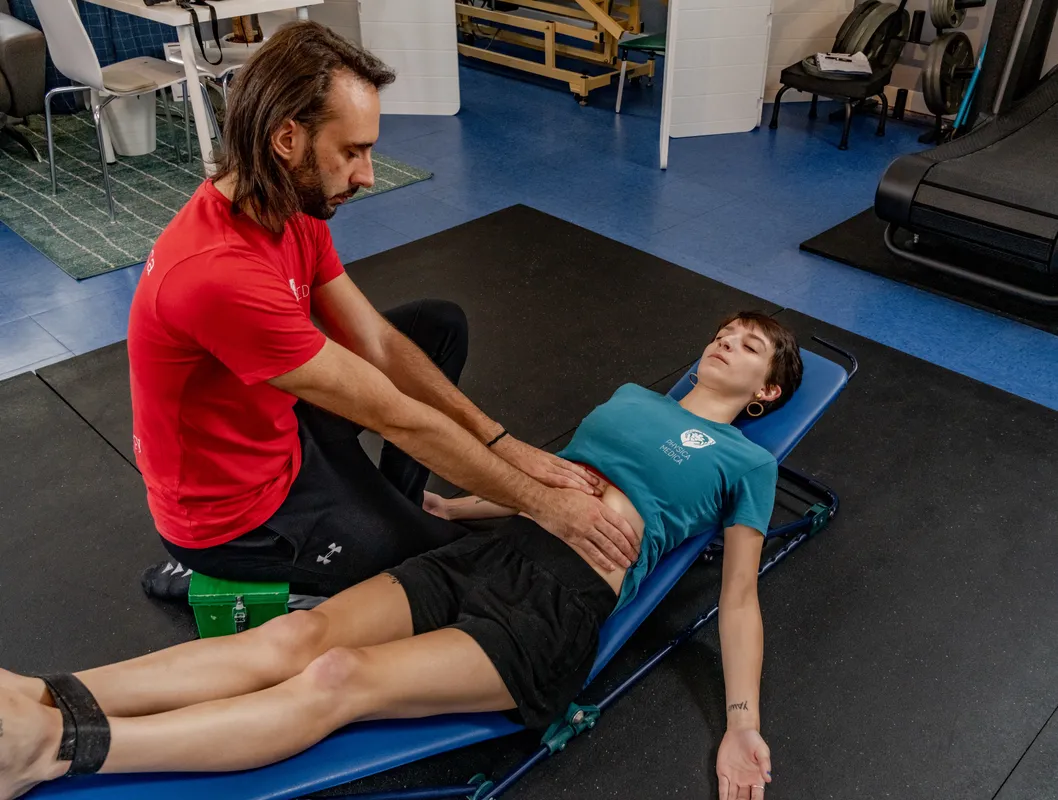
Diaphragmatic Rehabilitation in Baltimore
Dr. Maks Birikov, DPT · Manual therapy for breathing dysfunction, vocal tension, and the structural chain most practitioners never assess.
A full hour of hands-on work. No aides, no exercise handouts. Direct treatment of the diaphragm and the fascial system it connects to.
Out-of-network by design. HSA and FSA accepted.
Your Diaphragm Does More Than Help You Breathe
Most people think of the diaphragm as a breathing muscle. It is. But it is also a postural muscle, a pressure regulator, and a structural anchor. Its fascial connections reach far beyond the chest. The diaphragm shares connective tissue with the pericardium above, the psoas below, and the pelvic floor further still. When it stops moving freely, the effects show up in places that seem completely unrelated.
Chronic low back pain that never fully resolves. A hip that stays tight no matter how much you stretch. A singer whose jaw locks up under performance pressure. These are not separate problems. They are often the same problem, expressed in different locations.
This is the chain most practitioners miss: they treat the site of the symptom without ever assessing whether the diaphragm is the structure that set the whole pattern in motion.
What Diaphragmatic Rehabilitation Actually Involves
This is not a breathing exercise program. There are no worksheets, no apps, no instructions to breathe in for four counts and out for eight. Manual diaphragmatic rehabilitation means direct, hands-on work with the muscle itself: palpating its dome, assessing its excursion, and releasing the fascial restrictions that prevent it from moving through its full range.
This is for you if
- You want hands-on bodywork that addresses the diaphragm as a physical structure, not a concept to visualize.
- You have been told to 'work on your breathing' but nobody has ever put hands on the tissue and assessed what is actually restricted.
- Your breathing feels shallow, effortful, or asymmetrical, especially under stress or physical demand.
- You are a singer, speaker, or wind musician whose performance is limited by tension you cannot consciously release.
- You are pregnant or postpartum and your ribcage mobility and pelvic floor function have never been treated as a connected system.
This is not for you if
- You are looking for a guided meditation or breathwork class.
- Your breathing symptoms are cardiac or pulmonary in origin and have not yet been evaluated by a physician.
- You want a single session that resolves a pattern built over years.
- You prefer an exercise-based approach supervised by a PT aide.
The Tongue-Diaphragm-Facial Tension Connection
Here is what most singers and speakers have never been told about their tension. The jaw, the tongue, and the diaphragm are not independent structures. They are linked through a continuous fascial chain. When the diaphragm is restricted, locked in a guarding pattern from stress, injury, or chronic shallow breathing, the body compensates upward through the thoracic spine, into the neck, and eventually into the muscles of the tongue and jaw.
What this means for singers
A singer who presents with jaw tension or a locked tongue is often being told to treat the end of a chain, not the beginning. Releasing the jaw without addressing the diaphragm produces temporary results at best. The tension returns because its source has not changed. Dr. Birikov assesses the full system, diaphragm mechanics, thoracic mobility, hyoid position, tongue root tension, and treats the structure that is actually driving the pattern.
What this means for chronic pain patients
The diaphragm can become locked in a protective, guarding position following trauma, surgery, or prolonged stress. When it stops descending fully on the inhale, intra-abdominal pressure drops, the psoas compensates, and the lumbar spine loses its primary stabilizer. This is a well-documented pathway to chronic low back pain, and it is almost never assessed in a standard PT evaluation.
Who Needs Diaphragmatic Rehabilitation
Breathing dysfunction is rarely the chief complaint. More often, patients arrive with something else entirely, and the diaphragm turns out to be central to it.
- Singers and vocal performers with jaw tension, tongue tension, or restricted breath support
- Speakers, actors, and wind musicians whose performance is limited by breathing mechanics
- Patients with chronic low back pain that has not responded to standard treatment
- Patients with pelvic floor dysfunction, including those in prenatal or postpartum recovery
- Athletes whose breathing becomes a limiting factor under high-demand conditions
- Patients with post-surgical abdominal restrictions that have altered breathing mechanics
- Anyone whose diaphragm has never been directly assessed despite months or years of treatment elsewhere
- Scar Tissue & Post-Surgical Rehab
How This Work Connects to Singing, Speaking, and Chronic Pain
For singers and performers
Physica Medica is the only practice in Baltimore that treats vocal tension through the structural chain that produces it. That means assessing the diaphragm, the thoracic spine, the hyoid, and the muscles of the tongue and jaw as a single functional system. If you have worked with a voice teacher, a speech therapist, or a general PT and the tension keeps returning, the reason is likely that the assessment stopped before it reached the source.
For chronic pain patients
If your low back pain, hip restriction, or pelvic floor symptoms have been treated repeatedly without lasting results, a restricted diaphragm may be the structural variable nobody has addressed. This is not a fringe theory. The fascial connections between the diaphragm and the psoas complex, and from there into the pelvic floor, are anatomically documented and clinically significant. They are simply not part of most standard assessment protocols.
For pregnant and postpartum patients
As the uterus expands, the diaphragm is progressively compressed and its excursion reduced. After delivery, the pressure system of the trunk needs to re-coordinate: diaphragm, pelvic floor, deep abdominals working together again. Manual work that addresses diaphragm mechanics directly is a meaningful part of that recovery, not an add-on.
What to expect from treatment
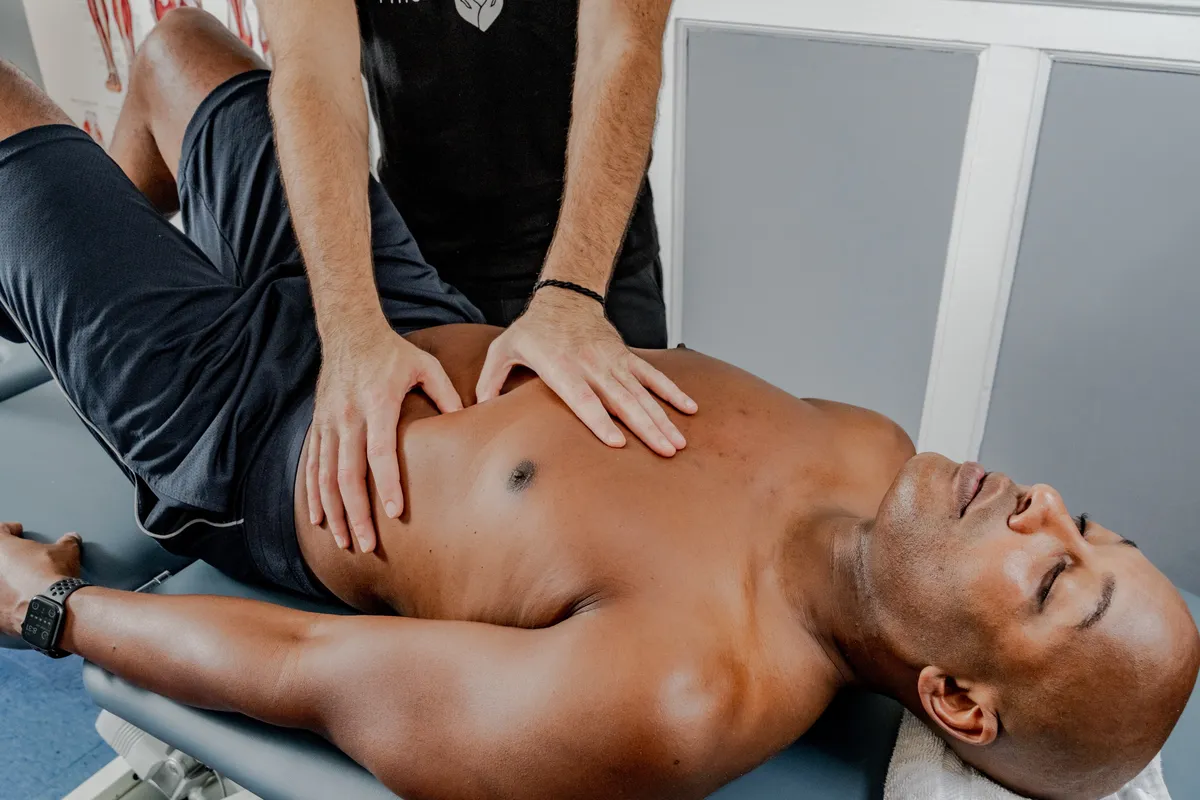
Direct manual release of the diaphragm involves sustained pressure at the costal margin and interior rib angles, combined with breath cuing to assess and improve excursion. It is not painful in the way that deep tissue massage is painful, but it is specific and requires you to breathe into the restriction rather than away from it. Most patients notice a change in breath depth within the first session.
Diaphragmatic work is often combined with fascial release of the thoracic spine, the psoas, and the pelvic floor depending on what the assessment reveals. The session is one hour, hands-on, with Dr. Birikov from start to finish.
Before You Book
How is one-on-one physical therapy different from PT at a regular clinic?
Is diaphragmatic rehabilitation the same as breathing exercises I can do at home? No. Breathing exercises train a pattern. Manual diaphragmatic rehabilitation changes the tissue that is preventing the pattern from being possible in the first place. If you have already tried breathwork, yoga breathing, or app-guided respiratory training and still feel restricted, that is the distinction that matters.
How many sessions will I need?
What is the connection between the diaphragm and jaw or vocal tension? The diaphragm and the structures of the jaw and tongue are connected through a continuous fascial chain running through the thoracic spine, cervical spine, hyoid, and tongue root. When the diaphragm is restricted, the body compensates upward through this chain. Treating the jaw without addressing the diaphragm resolves the symptom temporarily. Most patients with chronic vocal tension have never had the lower end of this chain assessed.
Do you take insurance for one-on-one physical therapy?
How does physical therapy treat breathing dysfunction? Through direct manual assessment and release of the diaphragm and its fascial connections, combined with evaluation of the thoracic spine, ribcage mobility, and the structures above and below. Dr. Birikov is a licensed Doctor of Physical Therapy in Maryland. This is manual therapy applied to a specific anatomical structure. Not a wellness practice. Not breathwork coaching.
Begin Your Breathing Rehabilitation in Baltimore
If you have been told your breathing is fine, your imaging is clean, or that you just need to relax, and none of that has changed how you feel, there is likely more to the picture than you have been shown. Send a message describing what you are experiencing, what you have already tried, and what has not been explained to your satisfaction.
Dr. Birikov reads every inquiry personally and responds directly. Physica Medica is located at 800 S Bond St, Baltimore, MD 21231. You can also reach the practice by phone at 443-228-8029.