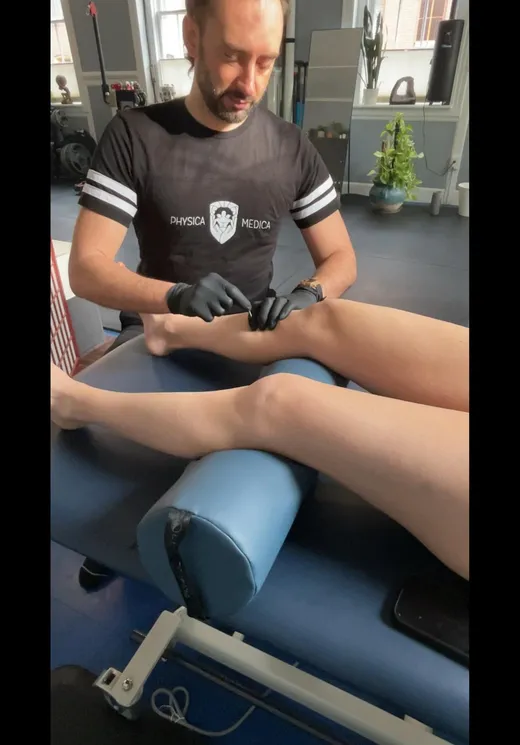
One-on-One Manual Therapy
Direct hands-on fascial release and joint mobilization at the knee, hip, and ankle. The goal is to restore the mechanics of the full chain so the knee stops absorbing load it shouldn't be carrying.
Learn more →
Hands-on treatment for knee pain that has already survived physical therapy, injections, or months of rest and kept coming back anyway.
Dr. Maks Birikov, DPT is a licensed physical therapist and the first master-certified dry needling practitioner in Baltimore.
Request a ConsultationFull-hour, one-on-one sessions in Fells Point. No aides. No rotating staff.
You probably already have a name for it. Patellar tendinopathy. IT band syndrome. Meniscal irritation. Chondromalacia. The diagnosis exists. The relief doesn't.
The knee is rarely the origin of the problem. It is the place that absorbs the load when something above or below it isn't moving correctly. A restricted hip, a locked ankle, a compressed lumbar segment can each shift the mechanics so that the knee takes more force than it was built to handle. Treat only the knee and the load pattern stays the same.
That upstream restriction is what most knee pain treatment never addresses. It is also why the pain comes back after a few weeks of feeling better.
The assessment starts at the foot and ends at the lumbar spine. Dr. Birikov is looking at how the whole lower kinetic chain loads, not just the segment that is currently inflamed.
He maps fascial restriction along the chain, identifies where joint mobility has been lost, and finds the trigger points that are altering muscle timing around the knee. That picture tells him where the manual work actually needs to happen.
Then the hands-on work begins. Release, mobilization, needling, instrument work: chosen for what the tissue is doing that day, not a preset protocol. The knee gets direct attention. So does everything feeding into it.
Most sessions draw on two or three of these methods. Which ones depend on what the assessment finds. Nothing is applied by default.
Direct hands-on fascial release and joint mobilization at the knee, hip, and ankle. The goal is to restore the mechanics of the full chain so the knee stops absorbing load it shouldn't be carrying.
Learn more →Instrument-assisted soft tissue mobilization uses steel-edged tools to detect and break down adhesion in the fascia and connective tissue around the knee. This is the kind of scar tissue buildup that accumulates after injury, surgery, or chronic overuse and doesn't release on its own.
Learn more →A fine filament needle is inserted into a trigger point in the quadriceps, IT band, calf, or hip musculature. The needle causes the muscle to release, reducing the chronic tension that is pulling the knee out of alignment. Dr. Birikov holds Maryland licensure for dry needling and is the first practitioner in Baltimore to hold master-level certification in the technique. This is not acupuncture. It targets neuromuscular trigger points based on anatomy, not meridian pathways.
Learn more →Suction cups create negative pressure that lifts the fascia away from the tissue layers beneath it. Around the knee and thigh, this restores glide between structures that have become stuck together, something compression-based massage cannot reach. Cupping often leaves circular marks that fade within a few days.
Learn more →Knee pain that travels into the shin, thigh, or involves numbness and tingling often has a nerve component. The sciatic or femoral nerve may be restricted where it passes through compressed tissue. Neural tension release frees the nerve at the actual site of restriction, not just where the symptom is felt.
Learn more →Once the restriction is cleared, the loading pattern gets addressed. If the hip still drops or the foot still collapses every time you take a step, the same forces return. This is not a home exercise program. It is hands-on correction of how the body distributes load during movement.
Learn more →A full hour with Dr. Birikov. The first fifteen minutes are assessment: movement, load patterns, tissue quality along the chain. The rest is hands-on work.
Deep tissue work can be intense during the session and may leave one to two days of soreness afterward. Cupping may leave visible circular marks that fade within a few days. These are normal responses, not signs of damage.
Most patients with chronic knee pain notice meaningful change within four to six sessions. Longer-standing patterns, post-surgical cases, or pain with a significant neural component may take longer. If your situation requires a realistic range, that conversation happens at intake, not after several sessions of guesswork.
Exercise-based PT loads a system that is still mechanically restricted. That is why it often helps briefly and then plateaus. The underlying restriction is still there, and the knee keeps absorbing the same abnormal forces.
The patients who get the most from this work are the ones who have already tried the standard path and found its limits. Prior treatment failure is not a reason to be skeptical. It is usually a sign that the root cause was never found.
Physica Medica does not bill insurance. Sessions are out of pocket. That is not a compromise. It is what makes full-hour, one-on-one work with a single doctor possible.
Send a message describing your knee pain, how long it has been there, and what treatments you have already tried. The more specific you are, the more useful Dr. Birikov's response will be.
Dr. Birikov reads every inquiry personally and responds directly. Physica Medica is located at 800 S Bond St, Baltimore, MD 21231. You can also reach the clinic at 443-228-8029.