Chronic Pain & Fascial Restriction Treatment in Baltimore | Physica Medica | Physica Medica
Skip to content
Physica Medica logo
Physica Medica logo Consult
Physica Medica logo
Request a Consultation
Back Pain · Baltimore

Treated. Repeatedly. Still There.

Chronic pain that has survived physical therapy, chiropractic, massage, and every other reasonable attempt at treatment usually has a cause that none of those approaches fully addressed. Fascial restriction — dense, adhered connective tissue that compresses joints, traps nerves, and limits the way your body moves — is one of the most common and most overlooked sources of persistent pain. It does not show on standard imaging. It does not resolve with exercise. And it does not respond to treatment aimed at the wrong layer.

Dr. Maks Birikov, DPT is a Maryland-licensed physical therapist and the first master-level dry needling practitioner in Baltimore. He is also one of the only practitioners in the United States trained in European fascial rehabilitation techniques — a clinical tradition with a different model of how chronic pain develops and a different set of tools for resolving it.

Request a Consultation

Full-hour, one-on-one sessions at 800 S Bond St in Fells Point. No referral required.

Why It Returns

What Is Fascial Restriction and Why Does It Cause Chronic Pain?

Fascia is the continuous web of connective tissue that surrounds every muscle, nerve, organ, and joint in your body. It is not a passive wrapping. It transmits force, supports posture, and communicates tension across the entire structure. When it becomes restricted — through injury, surgery, repetitive strain, prolonged immobility, or even chronic stress — it does not just cause local pain. It pulls on everything connected to it.

A restriction in the hip flexors can load the lumbar spine. Tightness through the thoracolumbar fascia can compress the ribcage and alter breathing. Adhesions along the posterior chain can refer pain into the legs in ways that look like sciatica but originate nowhere near the sciatic nerve. This is not a theoretical model. It is why so many patients have pain in one area and find that the actual restriction is somewhere else entirely.

Fascial restrictions are real, measurable, and treatable. They are also the part of the picture that most standard treatment never reaches.

The Approach

Why Chronic Pain Patients Often Don't Get Better With Standard Treatment

Standard physical therapy is built around exercise. The logic is sound in principle: strengthen the muscles around the painful area, improve stability, reduce load. The problem is that exercise loads a system that is still restricted. If the fascia is adhered and the joint is compressed, adding load does not release the restriction — it works around it at best, and aggravates it at worst. This is why so many patients report that PT helped briefly, then the pain came back.

Chiropractic adjustments address joint mobility, which is part of the picture. Massage addresses surface muscle tension, which is also part of the picture. Neither reaches the deep fascial layers where chronic restrictions typically live. Neither addresses the movement pattern that created the restriction in the first place. So the relief is real, but it does not last.

If you have already tried multiple providers and you are still in pain, that is not evidence that your pain is untreatable. It is evidence that the root cause has not been addressed yet. That distinction matters.

The Toolkit

European Fascial Techniques — What Makes This Approach Different

European fascial rehabilitation developed out of a clinical tradition that treats the body as a continuous tensional system rather than a collection of separate parts. Where standard myofascial release is typically applied locally — to the area that hurts — European fascial technique maps restriction patterns across the whole body and traces them to their mechanical origin. Treatment follows the chain, not the complaint.

The Practical Difference

I have had a low back/piriformis/hip flexor problem for years. As a yoga, Pilates, and barre instructor, managing that has been tough. When the pain became unignorable, I turned to dry needling. It has been the only method that truly helped me.

Learn more →

The Practical Difference

DR. MAKS BIRIKOV helped me walk again! If it weren't for his expertise, I would still be struggling with my pain and having my mobility severely limited. I can not recommend more highly!!

Learn more →
Documented

Conditions That Often Have a Fascial Root Cause

Fascial restriction is not a single diagnosis. It is a mechanism that underlies many conditions that are otherwise difficult to resolve. The following are among the most common presentations seen at Physica Medica.

Chronic and Recurring Pain

Before
After

Back pain, neck pain, and hip pain that returns after treatment — or that has been present for months or years without a clear structural cause on imaging — frequently has a fascial component. The same applies to tension headaches that originate in the suboccipital muscles and cervical fascia, and to shoulder pain that persists after rotator cuff treatment.

Honest Qualification

Treatments for Chronic Pain and Fascial Restrictions at Physica Medica

Manual Fascial Therapy

  • Hands-on release of adhered fascial layers using sustained pressure and specific mobilization techniques drawn from European fascial rehabilitation. This is not general massage. It is directed work on identified restriction points along the fascial chain.
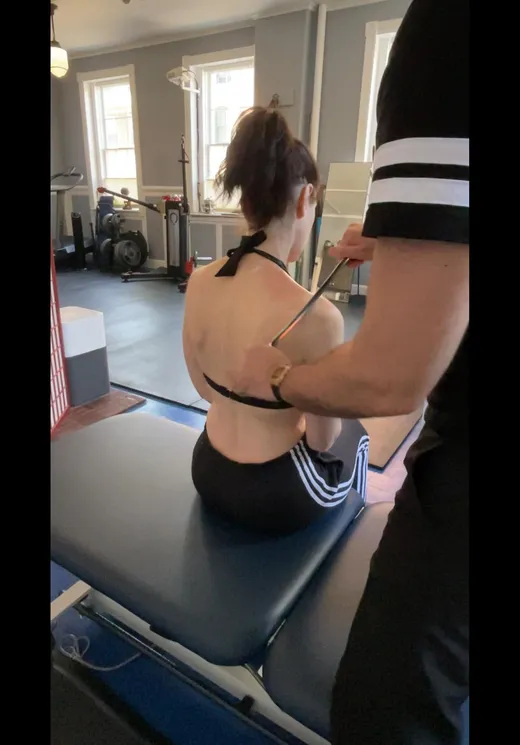
  • Specialized steel instruments are used to detect and break down adhesions in the fascia and connective tissue. The edge of the instrument transmits feedback about tissue texture that hands alone cannot always detect. Most patients describe it as a firm scraping sensation — intense in restricted areas, neutral in healthy tissue.
  • Dry needling uses a fine filament needle to reach a trigger point — a contracted, hypersensitive knot in the muscle or fascia — and cause it to release. The needle produces a brief involuntary twitch in the muscle, which is the release response. This is not acupuncture; it is not based on meridian theory. It is a direct mechanical intervention on the trigger point itself. Dr. Birikov holds a master-level dry needling certification and is the first practitioner at that credential level in Baltimore. Maryland-licensed physical therapists are legally permitted to perform dry needling.
  • Myofascial cupping uses negative pressure — suction — to lift the fascial layer away from the structures beneath it, creating space and restoring glide between tissue layers that have become adhered. Cupping can leave circular marks on the skin that fade within a few days. They are not bruises in the traditional sense; they are a response to the suction in areas of restricted circulation. Dr. Birikov will tell you before treatment whether marks are likely based on what he finds in the tissue.

IASTM — Instrument-Assisted Soft Tissue Mobilization

  • For chronic pain with radiating symptoms — numbness, tingling, or pain that travels into the arm or leg — the nerve is often mechanically compressed or adhered along its path, not only at the spine. Neural tension release addresses the nerve where it is actually restricted, which is often different from where imaging suggests the problem is.
  • You have red-flag symptoms such as progressive weakness or bowel and bladder changes, which need medical assessment now.
  • You are looking for insurance-billed visits three times a week.
  • You want one session to undo a decade-old pattern.
The Hour Itself

Start Your Chronic Pain Recovery in Baltimore

No referral is needed to book at Physica Medica. Sessions are one hour, one-on-one with Dr. Birikov. The first fifteen minutes of the initial visit are assessment: posture, movement, and palpation of the fascial chain. The remainder is hands-on treatment.

Deep manual work can be intense during the session and may leave one to two days of soreness afterward — similar to the feeling after a hard workout in a muscle that has not been used. This is normal and typically resolves quickly. Post-treatment bruising is uncommon with IASTM and dry needling; cupping marks are more predictable and Dr. Birikov will discuss them with you before starting.

Most patients with chronic fascial pain see meaningful change within four to six sessions. Long-standing patterns with multiple restriction sites take longer. At the end of the initial assessment, Dr. Birikov will give you a realistic estimate based on what he finds — not a vague range designed to avoid commitment.

Good Questions

Frequently Asked Questions

How is hands-on physical therapy different from exercise-based PT for back pain?

What is fascial therapy and how is it different from massage? Massage primarily addresses surface muscle tension through compression and friction. Fascial therapy targets the connective tissue layer beneath and between muscles — releasing adhesions, restoring glide between tissue layers, and following restriction patterns across the full body rather than working only on the area that hurts. The tools, the depth, and the clinical reasoning are different.

How many sessions will I need for back pain treatment?

Can fascial restrictions cause chronic pain throughout the body? Yes. Because fascia is a continuous system, a restriction in one area creates tension and altered loading across the entire chain. Patients often present with pain in multiple locations that seem unrelated — and frequently are, in terms of local tissue damage — but trace back to a single primary restriction site. This is one of the central reasons chronic pain is so poorly treated when each symptom is addressed in isolation.

Can you treat back pain that hasn’t responded to other therapies?

How many sessions does it take to see results from fascial treatment at Physica Medica? For most chronic pain patients, meaningful change is noticeable within four to six sessions. Acute or recent restrictions often respond faster. Long-standing patterns — particularly those involving multiple fascial lines or prior surgical scarring — require more time. Dr. Birikov will give you a condition-specific estimate after the initial assessment. Physica Medica does not bill insurance; sessions are paid out of pocket. The full-hour, one-on-one format is a direct consequence of doing the assessment and treatment properly.

The Next Step

Book a Session at Physica Medica

If you have been in pain for months, seen multiple providers, and still do not have a clear answer about why the pain keeps returning, a fascial assessment is the logical next step. Describe your condition, how long it has been present, and what treatments you have already tried. That information allows Dr. Birikov to give you a useful response before you even come in.

Dr. Birikov reads every inquiry personally and responds directly. Call 443-228-8029 or send a message through the contact form. Physica Medica is located at 800 S Bond St in Fells Point, Baltimore.

Preview Give Feedback