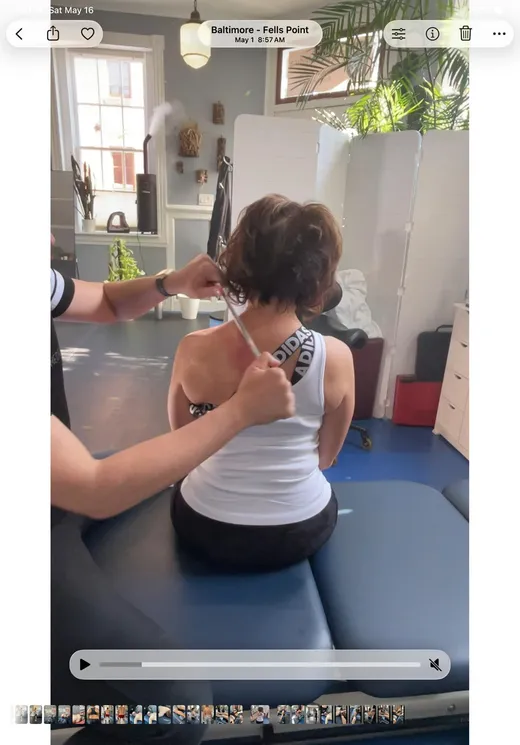
One-on-One Manual Therapy
Hands-on fascial release and joint mobilization along the whole chain. The backbone of every back pain plan here.
Learn more →
Hands-on treatment for chronic and recurring back pain that has already survived physical therapy, chiropractic, massage, and in many cases, injections.
Dr. Maks Birikov, DPT
First master dry needler in Baltimore
Full-hour, one-on-one sessions in Fells Point.
You already know what your back pain is called. You have the imaging, the diagnosis, and a folder of exercises. What you have not been told is why it keeps returning six weeks after every course of treatment ends.
Almost all back pain treatment is aimed at the place that hurts. But the lumbar spine is rarely the origin of its own problem. It is where the load ends up. Fascia thickened along the posterior chain, a rib cage that has stopped rotating, a hip that gave up its share of the work years ago: each of these quietly transfers stress into the low back, all day, every day. Release the painful segment and it feels better for a week. The pattern that loaded it is untouched, so the pain comes home.
That is the part most patients have never been shown. It is also the reason there is a straightforward way forward.
The assessment covers the whole posterior chain, not the sore segment. Heel to skull, standing, walking and breathing, then by hand.
He is mapping three things: fascial restriction along the chain, postural alignment that loads the spine asymmetrically, and compensations in the hips, pelvis and thoracic spine that pass their work down to the lumbar region. Treatment follows the map, which frequently means the first hour is spent nowhere near the painful area.
Then it is manual work: release, mobilization, needling, instrument work, for a full hour, by the doctor, every visit.
Chosen in the moment for what the tissue is doing. Most sessions use two or three of these.
Hands-on fascial release and joint mobilization along the whole chain. The backbone of every back pain plan here.
Learn more →Instrument-assisted soft tissue mobilization: steel edges read adhesion in the fascia that fingers pass over, then break it down.
Learn more →A fine filament needle reaches a trigger point in deep spinal musculature and lets it release. Dr. Birikov is Baltimore’s first master dry needler, and the technique is within the licensed scope of physical therapy practice in Maryland.
Learn more →Negative pressure lifts the fascia away from the layers beneath it, restoring glide and blood flow. The circular marks are normal and fade within a week.
Learn more →For back pain with radiating symptoms, the nerve is freed where it is actually bound, not where the numbness is felt.
Learn more →Once the restriction is gone, the loading pattern is retrained so the correction survives your working week.
Learn more →A full hour, one-on-one with Dr. Birikov. Roughly the first fifteen minutes are assessment: standing, walking, breathing, then palpation along the chain. The rest is treatment, adjusted as the tissue responds.
Deep work can be intense while it happens and can leave a day or two of soreness closer to hard exercise than injury. Cupping leaves circular marks that fade within a week. Pressure is discussed as he works.
Most back pain patients feel meaningful change within four to six sessions. Patterns twenty years in the making take longer, and Dr. Birikov will say so directly after the first visit rather than sell you a package before it.
Exercise-based PT loads a system that is still restricted, which is why relief so often lasts until the following week. Manual therapy removes the restriction first: fascial adhesion, a locked segment, a trigger point that will not release under pressure. Only then does it retrain the pattern. The difference is the order of operations, and for chronic back pain it is decisive.
Most patients feel meaningful change within four to six sessions. Recent, localized pain often resolves faster. Long-standing patterns with multiple compensations take a longer course, and you will be told which of those you are after the first assessment, with a specific range rather than an open-ended plan.
That is the majority of the practice. Prior treatment failure is usually a signal that the origin was never located, not that the back is untreatable. Bring what you have already tried and what each attempt changed. That history is diagnostic, and it shortens the search considerably.
Describe the pain, how long it has been there, and what has already failed. Dr. Birikov reviews every inquiry personally and will tell you plainly whether he can help.
Dr. Birikov reads every inquiry personally and responds directly.