
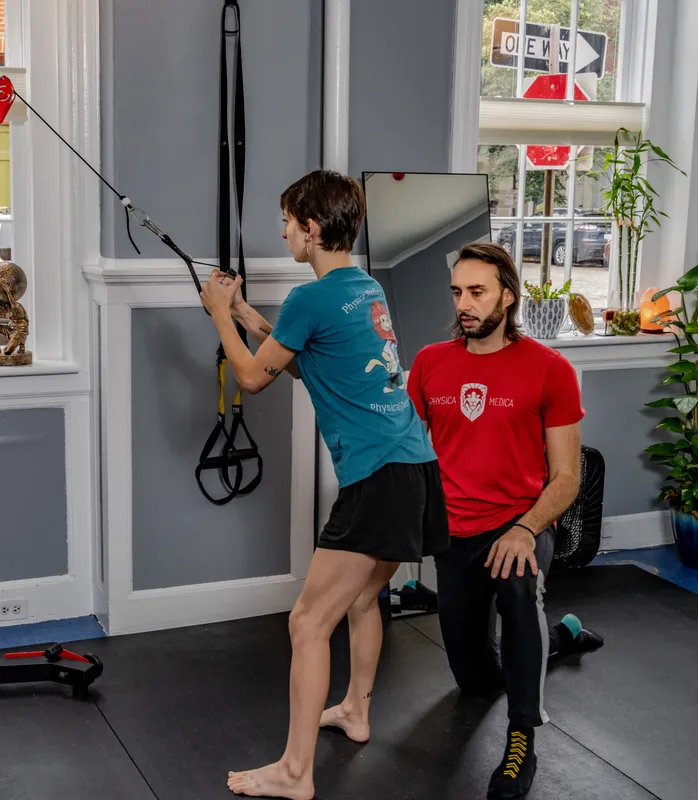
Rehabilitation Strength Training Built Around How Your Body Actually Moves
Dr. Maks Birikov, DPT · Baltimore's only Functional Patterns practitioner · Rehabilitation strength training prescribed after the manual therapy work is done
This is not a gym program with a physical therapist in the room. It is the functional restoration phase of real rehabilitation, the point where the tissue has been released and the body needs to learn how to move under load without falling back into the same dysfunction.
Out-of-network by design. HSA and FSA accepted.
Why Strength Training Belongs in Physical Therapy
Manual therapy fixes what is stuck. It releases tight fascia, clears trigger points, restores joint mobility, and breaks down the scar tissue that has been quietly rerouting your movement for years. But release is not the same as restoration. A muscle that has been guarded and underloaded for months does not automatically know how to fire correctly once the restriction is gone.
That is where rehabilitation strength training comes in. Not to build fitness. Not to add volume or increase a one-rep max. To teach the body to produce force through patterns it has been avoiding, so the manual therapy work holds.
Without this phase, many patients improve, plateau, and regress. The tissue tightens again because the movement pattern that created the problem was never actually changed. Strength training, prescribed correctly and at the right time, is what makes the results last.
Who Benefits from Rehabilitation Strength Training
This service is for patients who have already done the manual therapy work, or who are doing it concurrently, and whose bodies are ready to move under load again. It is also for patients whose pain has been traced to a movement dysfunction rather than an isolated tissue injury, and who need to rebuild the neuromuscular patterns that were lost.
This is for you if
- You have completed or are in the middle of manual therapy and need to consolidate the gains through controlled movement
- You have a recurring injury that keeps returning despite treatment, because the underlying movement pattern was never addressed
- You have been cleared to return to activity but feel unstable, asymmetrical, or unsure of how to load the area safely
- You want strength programming that is built around your specific biomechanics, not a generic protocol
- You are an athlete or performer who needs to return to high-demand activity without reinjury
This is not for you if
- You are looking for fitness coaching, hypertrophy programming, or performance training outside of a rehabilitation context
- You have an acute injury that has not yet been assessed or stabilized
- You want an exercise program to substitute for hands-on treatment of an unresolved structural problem
- You need a clinic that bills insurance directly and programs exercise through an aide
How Dr. Birikov Integrates Strength Work with Manual Therapy
Physica Medica's approach to strength training is informed by Functional Patterns, a biomechanics methodology built around the four fundamental human movement patterns: standing, walking, running, and throwing. Dr. Birikov is the first and only Functional Patterns practitioner in Baltimore.
What Functional Patterns changes about rehabilitation programming
Most rehab exercise is isolated. Strengthen the glute. Activate the rotator cuff. Stabilize the core. Functional Patterns asks a different question: how does this muscle contribute to gait mechanics, rotational load transfer, and whole-body movement chains? Strength work is programmed around those chains, not around the muscle in isolation.
The sequence matters
At Physica Medica, strength training is never the primary treatment for an unresolved dysfunction. Manual therapy comes first. Tight fascia, restricted joints, and active trigger points have to be addressed before the body can move correctly under load. Attempting to strengthen through a compensation pattern just reinforces the compensation. The sequence is: release the restriction, restore the movement, then build capacity through that restored pattern.
Conditions Treated with Rehabilitation Strength Training
Rehabilitation strength training at Physica Medica is appropriate for a specific range of presentations, primarily chronic or recurring problems where movement dysfunction is part of the picture, and post-treatment cases where the tissue has been addressed but the pattern has not.
- Chronic low back pain with movement avoidance patterns
- Recurring sports injuries: hamstring, rotator cuff, ankle
- Post-surgical rehabilitation, late-stage loading phase
- Hip and knee dysfunction tied to gait asymmetry
- Postural dysfunction affecting load distribution
- Sciatica or nerve pain that has been manually treated and needs movement retraining
- Neck and shoulder dysfunction in overhead athletes or performers
- All conditions treated
What to Expect in a Rehabilitation Strength Training Session
Movement assessment first
Very attentive and great workout.
Post-session soreness is normal when reintroducing load to patterns that have been dormant. It is different from pain, and Dr. Birikov will explain the distinction before you leave.
Before You Book
How is one-on-one physical therapy different from PT at a regular clinic?
How is rehabilitation strength training different from personal training or gym workouts? Personal training is oriented toward fitness outcomes: strength, conditioning, body composition. Rehabilitation strength training at Physica Medica is oriented toward one thing: restoring normal movement mechanics after injury or dysfunction. Every exercise is selected because of what it does to a specific movement pattern, not because of its general fitness value. And it is delivered by a licensed Doctor of Physical Therapy, not a fitness coach.
How many sessions will I need?
When in my recovery should I start strength training? Not at the beginning. Manual therapy addresses the restriction first. Most patients begin incorporating strength work two to four sessions in, once the tissue has responded and the movement pattern has enough range to load correctly. Starting too early, before the fascia and joints are moving freely, means training the compensation, not the correction.
Do you take insurance for one-on-one physical therapy?
Can strength training be combined with manual therapy in the same session? Yes, and at Physica Medica it often is. If a restriction surfaces during movement assessment, it gets treated in the same visit before the loading work begins. This is one of the advantages of one-on-one sessions with the doctor rather than a divided-attention clinic model: the session responds to what the body shows, not to a preset protocol.
Book a Rehabilitation Strength Training Session
Send a description of what you are dealing with: what hurts, how long it has been going on, what you have already tried, and what you are trying to get back to. If you are already working through a manual therapy course of treatment elsewhere and want to add the strength component, say that too.
Dr. Birikov reads every inquiry personally and responds directly. Physica Medica is located at 800 S Bond St, Baltimore, MD 21231. You can also reach the clinic at 443-228-8029.