
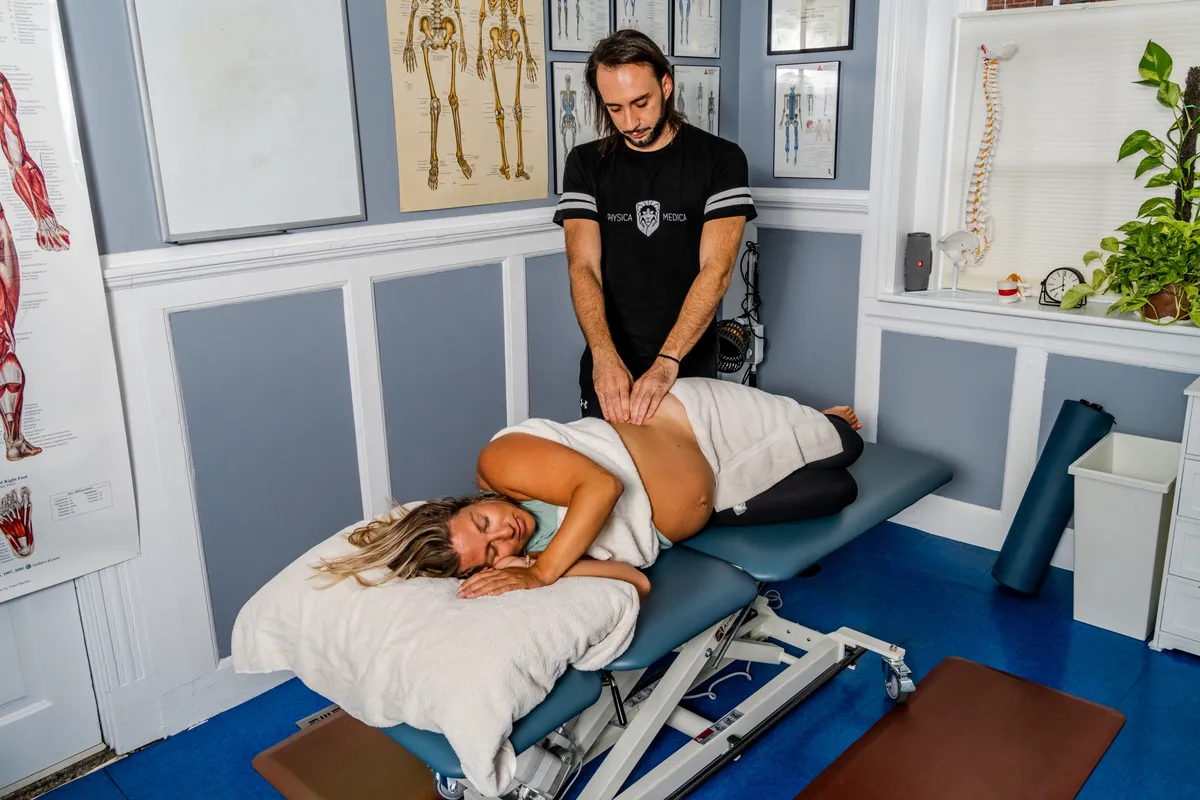
Physical Therapy Designed for the Pregnant Body, Not a Generic Protocol
Dr. Maks Birikov, DPT provides hands-on manual therapy for pregnant patients at Physica Medica in Baltimore. Every session is one-on-one, with Dr. Birikov for the full hour. No aides, no exercise handouts, no rotating staff.
Pregnancy changes the body fast. The pelvis shifts, the ribcage expands, the diaphragm gets compressed, and the soft tissue holding everything together is under load it has never experienced before. When pain shows up in the pelvis, the low back, the hips, the ribs, it is not random. It has a mechanical explanation. And it responds to the right hands-on treatment.
Out-of-network by design. HSA and FSA accepted.
What Pregnancy PT at Physica Medica Addresses
This is not a general 'prenatal wellness' service. The conditions treated here are specific musculoskeletal problems caused or worsened by the physiological demands of pregnancy.
Pelvic girdle pain and symphysis pubis dysfunction: the sacroiliac joints and pubic symphysis are under increased load as relaxin loosens ligamentous support. Manual therapy addresses the joint mechanics and the surrounding soft tissue directly. Round ligament pain: sharp, pulling groin pain that most providers simply tell patients to tolerate. The fascial connections driving that tension can be treated. Thoracic tension and rib flare: as the uterus rises and the ribcage expands, the thoracic spine stiffens and the mid-back becomes a constant source of aching. Diaphragmatic restriction: shortness of breath in pregnancy is not always just the baby pressing up. Fascial restriction around the diaphragm compounds the problem and responds well to manual release. Low back pain and sciatica: nerve compression and sacral dysfunction during pregnancy are common and treatable without medication.
If you are experiencing breathing difficulty alongside other pregnancy symptoms, see the diaphragmatic rehabilitation page for more on how restricted breathing mechanics are assessed and treated.
How Hands-On Bodywork Differs from Exercise-Based Prenatal PT
Most prenatal physical therapy is exercise-based. You are assessed, given a home program, and coached through movements designed to stabilize the pelvis and strengthen the core. That approach has value, but it is not what happens here.
This is for you if
You want direct, hands-on treatment for the source of the pain, not a program of exercises to manage it.
- You have already seen a provider for pregnancy pain and are still hurting.
Your pain is specific and mechanical: pelvic girdle, symphysis pubis, rib pain, sciatica, thoracic tension. You want it assessed by someone who treats these conditions with manual therapy.
- You want one uninterrupted hour with the doctor, not a divided visit split between an aide and a brief check-in.
- You are willing to pay out of pocket for that level of attention.
This is not for you if
- You are looking for a supervised exercise program or prenatal fitness coaching.
- You need a clinic that bills insurance directly.
- You have an obstetric concern that requires evaluation by your OB or midwife first.
- You expect a single session to resolve a pattern that has built over months.
Is Pregnancy Physical Therapy Safe? What to Know
Manual therapy during pregnancy is safe when performed by a licensed physical therapist with specific training in prenatal musculoskeletal care. Dr. Birikov holds a Doctor of Physical Therapy degree and is licensed in Maryland. Treatment is adapted throughout pregnancy: positioning, pressure, and technique are all modified based on trimester and individual presentation.
On dry needling during pregnancy
Dry needling is not performed during pregnancy at Physica Medica. Manual soft tissue work, myofascial release, joint mobilization, and instrument-assisted techniques are the primary tools used in prenatal treatment. Maryland law permits licensed physical therapists to perform dry needling; the decision not to use it during pregnancy is a clinical one, not a legal one.
On cupping during pregnancy
Cupping is a technique that uses suction to decompress restricted fascia and increase circulation in the tissue. It can be applied safely in pregnancy with appropriate site selection and pressure. It may leave temporary marks on the skin, similar in appearance to a bruise but different in mechanism. These typically resolve within a few days. If visible marks are a concern, that is worth discussing before the session.
When to Start, and What to Expect
There is no required trimester to begin. Pelvic girdle pain that starts at twelve weeks does not need to be tolerated until the third trimester. The earlier the mechanical problem is addressed, the less compensatory tension builds around it.
- First session: full assessment of posture, movement, breathing mechanics, and palpation of the relevant soft tissue and joints. Treatment begins the same visit.
- Session count: most patients with pregnancy-related musculoskeletal pain see meaningful change within four to six sessions. The range depends on how long the problem has been present and how many compensatory patterns have developed around it.
- Post-treatment soreness: hands-on work on restricted tissue can produce one to two days of soreness after a session. This is normal and expected. It should not prevent you from functioning. If you have concerns about how your body responds to manual treatment, raise them before the session begins.
- No referral required. You do not need a prescription or a referral from your OB to book. Informing your OB or midwife that you are receiving physical therapy is always a good idea; their clearance is not required to schedule.
Frequently Asked Questions
Is hands-on physical therapy safe during pregnancy?
Yes, when performed by a licensed DPT with prenatal training. Dr. Birikov modifies all techniques for pregnancy. Positioning, depth of pressure, and the specific tools used are all adjusted based on trimester and individual presentation. Certain techniques, including dry needling, are not used during pregnancy as a matter of clinical practice.
What pregnancy symptoms can physical therapy actually help with?
The conditions most responsive to manual therapy during pregnancy include pelvic girdle pain, symphysis pubis dysfunction, round ligament pain, low back pain, sciatica, thoracic tension, rib pain, and diaphragmatic restriction. If your symptom is not on that list, it is still worth describing it when you reach out. The intake process exists to determine whether manual therapy is appropriate for your specific presentation.
How is this different from prenatal yoga or a prenatal massage?
Prenatal yoga and massage are wellness services. This is clinical physical therapy performed by a licensed DPT, directed at a specific mechanical diagnosis. The assessment identifies where the dysfunction is and why it is producing your symptoms. Treatment is targeted at that finding, not at general relaxation or general movement. If you have already tried massage and the pain came back within days, that pattern is exactly what clinical manual therapy is designed to address.
An honest arc
Before you leave, an estimate of how many sessions this will take and what will change first. Most patients feel meaningful change within four to six.
Deep manual work can be intense while it is happening and can leave a day or two of soreness, the kind that follows hard exercise rather than injury. Cupping can leave circular marks that fade within a week. Dr. Birikov talks through pressure as he works and adjusts on request. Nobody is asked to endure anything silently.
Book Your Prenatal PT Appointment in Baltimore
How is one-on-one physical therapy different from PT at a regular clinic?
Physica Medica is located at 800 S Bond St, Baltimore, MD 21231. Reach out by phone at 443-228-8029 or send a message through the contact form. Describe what you are experiencing, how far along you are, and what you have already tried. Dr. Birikov reads every inquiry personally and responds directly.
How many sessions will I need?
You do not need a referral. You do not need to be an existing patient. You need a clear description of the problem and a willingness to have it looked at by someone who will spend the full hour figuring it out.