Hip Pain Treatment in Baltimore | Physica Medica
Skip to content
Physica Medica logo
Physica Medica logo Consult
Physica Medica logo
Request a Consultation
Back Pain · Baltimore

Treated. Still Hurts. Still There.

Hip pain that has already survived physical therapy, chiropractic, cortisone, and rest is telling you something: the source hasn't been found yet. At Physica Medica, that is exactly where the work starts.

Dr. Maks Birikov, DPT, is a licensed physical therapist and the first master-certified dry needling practitioner in Baltimore.

Request a Consultation

Full-hour, one-on-one sessions in Fells Point. No aides. No handoffs. No exercise circuits.

Why It Returns

Why Hip Pain Keeps Coming Back

You may already have a name for it. Labral tear. Hip impingement. Bursitis. Greater trochanteric pain syndrome. The imaging exists. The diagnosis is on paper. And you are still in pain.

The hip sits at the intersection of the lumbar spine, the pelvis, and the lower extremity. When something is restricted above or below it — tight thoracolumbar fascia, a locked sacroiliac joint, a compressed neural pathway from the lumbar spine — the hip absorbs that load on every step. Treating the hip in isolation leaves the driver untouched.

That is the part most patients have never been shown. It is also the reason the relief from prior treatment never lasted.

The Approach

How Dr. Birikov Treats Hip Pain Differently

The assessment doesn't start at the hip. It starts at the foot and works up through the ankle, knee, pelvis, and lumbar spine, because restriction anywhere in that chain changes how load reaches the hip joint.

Dr. Birikov is identifying three things: where the fascia is restricted along the chain, where joint mobility is compromised, and whether any neural tension is contributing to the symptom pattern. Hip pain with groin referral, lateral thigh ache, or symptoms that travel toward the knee often have a neural component that goes unaddressed in standard care.

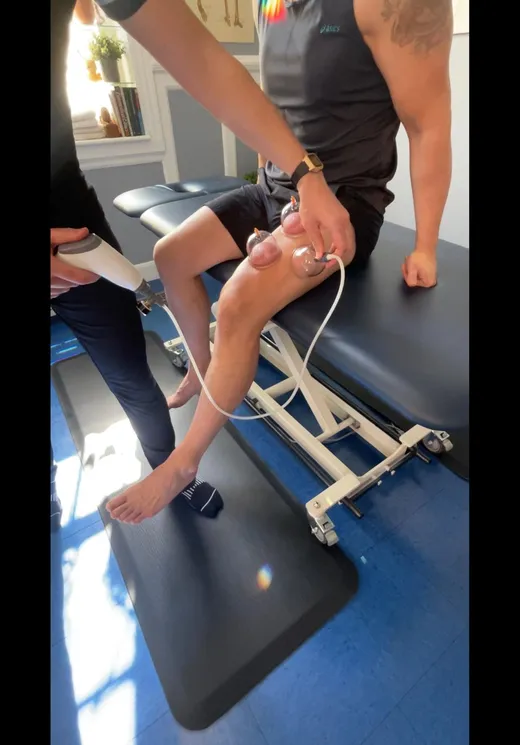
Once the picture is clear, the session becomes hands-on work: manual release, instrument work, dry needling, cupping, or neural mobilization, chosen for what the tissue is actually doing that day. Every session is a full hour.

The Toolkit

Treatments Used for Hip Pain at Physica Medica

No single protocol fits every presentation. Most sessions draw on two or three of the following, selected based on what the assessment finds.

One-on-One Manual Therapy

Direct hands-on release of the hip capsule, iliotibial band, hip flexor complex, and surrounding fascia. Joint mobilization where the hip or sacroiliac joint is restricted. The work follows the whole posterior and lateral chain, not just the spot that hurts.

Learn more →

IASTM

Instrument-assisted soft tissue mobilization uses precision steel edges to locate and break down adhesion in the fascia and connective tissue around the hip. It reaches layers that hands alone cannot access and is particularly effective on chronic scar tissue from old strains or post-surgical restriction.

Learn more →

Dry Needling

A fine filament needle is placed directly into a trigger point in the deep hip musculature — the piriformis, gluteus medius, hip flexors — causing the muscle to release its sustained contraction. Dr. Birikov holds Maryland licensure for dry needling and a master-level certification. This is a clinical procedure, not acupuncture.

Learn more →

Myofascial Cupping

Negative pressure lifts the fascia away from the layers beneath it, restoring glide between tissue planes that have become adhered. Cupping can leave temporary circular marks on the skin. They are not bruises and typically fade within a few days.

Learn more →

Neural Tension Release

Hip pain that radiates into the groin, lateral thigh, or down toward the knee is often partly neural. The sciatic nerve, femoral nerve, or lateral femoral cutaneous nerve can be compressed or restricted at multiple points along their path. Neural mobilization frees the nerve where it is actually being loaded, not just where the symptom appears.

Learn more →

Postural Load Correction

Once tissue restriction is cleared, the way the body loads the hip during standing, walking, and movement is addressed directly. Without this, the same restriction pattern returns. This is not a home exercise program — it is manual guidance of movement during the session itself.

Learn more →
Documented

What Progress Looks Like

Standing posture and gait are assessed at intake and tracked as sessions progress. Changes in pelvic tilt, hip alignment, and movement quality are visible before pain scores fully resolve — which is often the first concrete sign that the underlying pattern is shifting, not just the symptom.

A representative case: chronic lateral hip pain, six sessions

Before
After

Iliotibial band and deep hip rotator restriction released over the first three sessions. Lumbar and sacroiliac contribution identified and addressed in sessions four and five. By session six, the patient reported meaningful reduction in daily pain and full return to running. Individual results depend on the duration and complexity of the presentation.

Honest Qualification

Who This Is For — and Who It Isn't

This is for you if

  • Your hip pain is chronic or keeps returning after treatment that helped briefly
  • You have already done conventional PT, chiropractic, or massage without lasting change
  • You want hands-on manual therapy, not a supervised exercise circuit
  • You are prepared to pay out of pocket for full-hour sessions with the doctor

This is not for you if

  • You have an acute traumatic injury that requires imaging or surgical evaluation first
  • You have red-flag symptoms such as progressive weakness, instability, or unexplained swelling that has not been medically evaluated
  • You are looking for insurance-billed visits three times a week
  • You expect one session to resolve a pattern that has been building for years
The Hour Itself

Hip Pain Treatment in Baltimore: What to Expect

The first session is a full hour with Dr. Birikov. The first fifteen minutes or so are assessment — movement, palpation, load testing across the chain. The rest is hands-on treatment. You leave having already received care, not having scheduled it.

Deep tissue work and dry needling can be intense in the moment and may leave one to two days of soreness afterward. This is normal and expected. It is not a sign that something went wrong. Plan accordingly if you have a physically demanding day the following morning.

Most hip pain patients see meaningful change within four to six sessions. Longer-standing patterns or post-surgical presentations may require more. If your case falls into that category, Dr. Birikov will tell you that at intake rather than after six sessions.

Good Questions

Before You Decide

How is hands-on physical therapy different from exercise-based PT for back pain?

Exercise-based PT loads a system that is still restricted. That is why pain returns when the exercises stop — the underlying tissue problem was never cleared. Manual therapy addresses the restriction first. Movement follows.

How many sessions will I need for back pain treatment?

Prior treatment failure is not a sign that your case is hopeless. For most patients who come to Physica Medica, it is a sign that the right tissue was never targeted. That distinction matters.

Can you treat back pain that hasn’t responded to other therapies?

This is an out-of-pocket practice. Sessions are not billed to insurance. The concierge model exists because doing this work properly requires time, attention, and a one-on-one structure that insurance reimbursement rates do not support.

The Next Step

Book a Session or Send a Question

Describe your hip pain, how long it has been present, and what treatments you have already tried. That information lets Dr. Birikov tell you before you book whether this is the right fit for your presentation.

Dr. Birikov reads every inquiry personally and responds directly. Physica Medica is located at 800 S Bond St, Baltimore, MD 21231. You can also reach the office at 443-228-8029.

Preview Give Feedback