Breathing Dysfunction Treatment in Baltimore | Physica Medica | Physica Medica
Skip to content
Physica Medica logo
Physica Medica logo Consult
Physica Medica logo
Request a Consultation
Back Pain · Baltimore

Breathing Dysfunction Treatment in Baltimore

Most patients who come in for neck pain, back pain, jaw tension, or vocal strain have one thing in common: nobody has looked at how they breathe. The diaphragm sits at the center of posture, core stability, and fascial tension throughout the body. When it stops working correctly, the effects travel far from the chest — and they don't resolve until the source is addressed.

Dr. Maks Birikov, DPT is the first Wim Hof Method certified instructor in Baltimore and holds a master-level credential in dry needling. He treats breathing dysfunction as a clinical condition with measurable downstream effects, not a wellness add-on.

Request a Consultation

Full-hour, one-on-one sessions at 800 S Bond St in Fells Point.

Why It Returns

What Is Breathing Dysfunction and Why Does It Matter?

Breathing dysfunction doesn't mean you can't breathe. It means the diaphragm has stopped doing its full job — and other structures have quietly taken over. Neck muscles, shoulder muscles, and accessory chest muscles begin compensating. Over time, that compensation pattern becomes the new normal, and the problems it creates get treated as separate conditions.

Shallow chest breathing increases tension in the cervical spine and jaw. It reduces intra-abdominal pressure, which destabilizes the lumbar spine. It compresses the thoracic cage, limiting rib mobility and forward head correction. None of those downstream effects will resolve with treatment aimed at the neck, the jaw, or the low back alone.

That is the part most patients — and many practitioners — have never been shown. If you have been treated for neck pain, back pain, or vocal tension without any assessment of how you breathe, there is a real chance you have not yet addressed the actual problem.

The Approach

The Diaphragm's Role in Pain, Posture, and Performance

The diaphragm is not just a breathing muscle. It is a postural muscle. It attaches to the lumbar spine, the lower ribs, and the sternum, and it shares fascial connections with the pelvic floor, the psoas, and the thoracolumbar fascia. When it contracts and descends on inhalation, it creates the intra-abdominal pressure that stabilizes the spine before any movement begins.

When that mechanism is impaired, the body compensates. The lumbar extensors brace. The hip flexors tighten. The thorax stiffens. Patients end up with chronic low back pain, anterior hip restriction, or a rib cage that doesn't rotate — and they cycle through treatment after treatment for each symptom without anyone connecting them back to a single source.

For singers and speakers, the diaphragm is also the engine of breath support. Restriction there creates tension up the chain: into the tongue, the jaw, the larynx. That is why jaw work and vocal strain treatment at this practice always includes an assessment of breathing mechanics. The chain runs in both directions.

The Toolkit

How Dr. Birikov Treats Breathing Dysfunction

The assessment maps the whole respiratory chain: diaphragm mobility, rib cage expansion, accessory muscle recruitment patterns, and how breathing mechanics interact with posture and movement. The goal is to find where restriction is living and what it has already affected downstream.

Diaphragmatic Rehabilitation

Hands-on facilitation of correct diaphragmatic movement, combined with rib cage mobilization and postural re-education. The goal is restoring full excursion of the diaphragm and reducing the compensatory load on the neck and shoulders.

Learn more →

IASTM

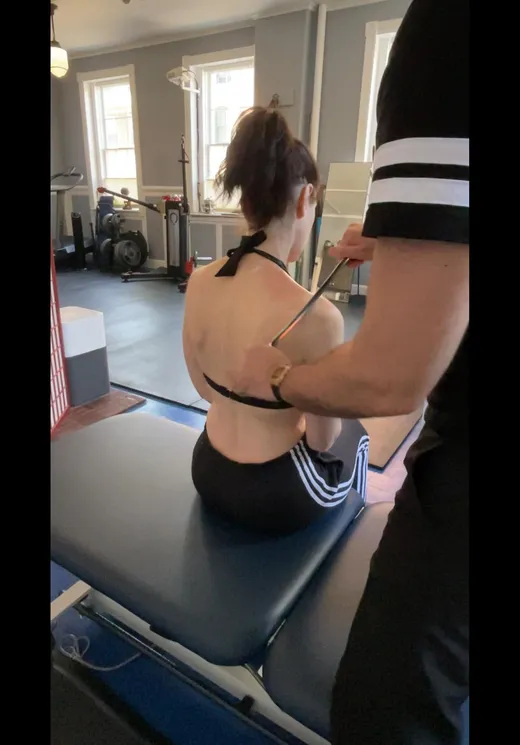
Instrument-assisted soft tissue mobilization uses calibrated steel instruments to detect and break down fascial adhesion in the intercostals, anterior chest wall, and thoracolumbar region. Restricted fascia limits rib cage expansion; releasing it restores the mechanical space the diaphragm needs to descend.

Learn more →

Dry Needling

A fine filament needle is placed directly into a trigger point in the respiratory musculature — diaphragm, intercostals, scalenes, or thoracic paraspinals — causing an involuntary release of the contracted tissue. Dr. Birikov holds a master-level dry needling credential and is licensed under Maryland physical therapy practice standards to perform this treatment.

Learn more →

Myofascial Cupping

Negative pressure cups lift the fascia away from the layers beneath it, restoring glide between the thoracic and respiratory tissues. Cupping can leave temporary circular marks on the skin — these typically fade within a few days and are a normal response to the decompression, not bruising from impact.

Learn more →

Wim Hof Method Breathing

As the first certified Wim Hof instructor in Baltimore, Dr. Birikov offers structured breathing workshops that teach controlled diaphragmatic breathing patterns through progressive practice. For patients in clinical rehabilitation, the workshop provides a framework to reinforce what the manual work has restored.

Learn more →

Posture Re-Education

Once the restriction is gone, the loading pattern is retrained so the correction survives your working week.

Learn more →
Documented

Treatments for Breathing Dysfunction at Physica Medica

Treatment is selected based on what the tissue is doing in that session. Most visits draw on two or three of the following.

What to Expect From Treatment

Before
After

Sessions are one full hour, one-on-one with Dr. Birikov. The first portion of each visit is assessment: how the tissue has responded since the last session, what has changed, and what needs attention next. Manual work follows for the remainder of the hour.

Honest Qualification

Breathing Dysfunction in Singers, Speakers, and Chronic Pain Patients

Singers and vocal performers

  • Jaw tension, tongue tension, and restricted breath support almost always share a common origin in diaphragmatic restriction. Treating the jaw without addressing the breath rarely produces lasting results.
  • Singers who have already worked with voice teachers or speech therapists without resolving tension in the throat or tongue may have an underlying breathing mechanics problem that manual therapy can address directly.
  • Dr. Birikov treats a dedicated population of singers and vocal performers in Baltimore. This is not a general PT clinic that occasionally sees performers — it is a practice built around the specific demands of the voice.
  • You are prepared to pay out of pocket for full-hour sessions with the doctor.

Chronic pain patients

  • Persistent low back pain that hasn't responded to lumbar treatment may be driven by diaphragmatic restriction affecting spinal stability — not by anything wrong with the lumbar spine itself.
  • Chronic neck pain with forward head posture is frequently maintained by accessory breathing patterns that keep the cervical extensors under constant load.
  • If you have been to PT, chiropractic, or massage for neck or back pain and the relief doesn't last, the question worth asking is whether anyone has assessed your breathing mechanics.
  • You want one session to undo a decade-old pattern.
The Hour Itself

Start Breathing Better in Baltimore

Physica Medica is located at 800 S Bond St in Fells Point. No referral is required to book. New patients are welcome.

Most patients with breathing dysfunction see meaningful change within four to six sessions. Complex cases involving long-standing postural compensation or chronic vocal strain may take longer — Dr. Birikov will give you an honest assessment of what to expect after the first visit, not before.

Describe your symptoms, what you have already tried, and what hasn't worked. Dr. Birikov reads every inquiry personally and responds directly. Call 443-228-8029 or send a message through the contact page.

Good Questions

Frequently Asked Questions

How is hands-on physical therapy different from exercise-based PT for back pain?

Can physical therapy treat breathing dysfunction? Yes. Physical therapists trained in manual therapy and diaphragmatic rehabilitation can assess and treat the musculoskeletal and fascial restrictions that impair breathing mechanics. This is different from pulmonary rehabilitation, which addresses lung disease. Breathing dysfunction in the context of posture, chronic pain, and vocal performance is a soft tissue and movement problem — and it responds to hands-on treatment.

How many sessions will I need for back pain treatment?

What is diaphragmatic rehabilitation and who needs it? Diaphragmatic rehabilitation is the clinical process of restoring full, coordinated diaphragmatic movement after it has been compromised by restriction, compensation, or injury. It combines manual release of the surrounding tissues with retraining of the breath pattern. Patients who benefit most are those with chronic low back pain, neck pain with forward head posture, vocal tension, jaw dysfunction, or a history of chest or abdominal surgery.

Can you treat back pain that hasn’t responded to other therapies?

How is breathing dysfunction connected to chronic pain and posture? The diaphragm attaches directly to the lumbar spine and shares fascial connections with the pelvic floor, psoas, and thoracolumbar fascia. When diaphragmatic function is impaired, intra-abdominal pressure drops and the lumbar spine loses its primary stabilizer. The body compensates with the lumbar extensors and hip flexors, which leads to chronic low back tension, anterior pelvic tilt, and reduced thoracic mobility. Treating the lumbar spine without restoring diaphragmatic function addresses the compensation, not the cause.

The Next Step

Before You Book

Physica Medica does not bill insurance. Sessions are paid out of pocket. That model exists because it is what makes one-on-one, full-hour treatment with a single treating doctor possible — not as a convenience feature, but as the basic condition for doing the work correctly.

If you have questions about whether this is the right fit for your situation, send a message with your history. Dr. Birikov reads every inquiry personally and responds directly.

Preview Give Feedback